
Type “CRT” into a search bar and you’ll see a lineup of old TVs, a culture debate, a pacemaker setting and, somewhere down the list, our topic today: Credit Risk Transfer.
Why it matters: It’s the quietest CRT out there, but it’s supported by a hefty balance sheet.
The big picture: CRT, once a niche function within Fannie Mae and Freddie Mac (the GSEs), is now grabbing attention in Washington. Lawmakers from both sides are urging FHFA Director Bill Pulte to broaden its use.
The stakes: With policymakers considering the release of Fannie Mae and Freddie Mac from conservatorship, deciding who takes on mortgage credit losses is more crucial than ever. CRT has quietly been the go-to solution for over a decade.
1. Big Thing: The ABCs of CRT
Before 2013, the GSEs held nearly all the mortgage credit risk in the conventional U.S. housing finance system on their own balance sheets, almost $5 trillion worth at the time of the 2008 crisis.
- When borrowers defaulted en masse, taxpayers picked up the tab to the tune of $187.5 billion in capital injections.
The fix: Credit risk transfer. Starting in 2013, under then-FHFA Acting Director Ed DeMarco, the GSEs began selling slices of that mortgage credit risk to private investors and reinsurers.
Why it matters: CRT keeps the GSEs doing what they do well, buying mortgages and providing market liquidity, while shifting a layer of credit risk off taxpayers and onto the private capital markets.
What They’re Saying:
“What that was going to do over time, it was going to shift Fannie and Freddie away from a principal world of guaranteed mortgage credit into more of a role in intermediating in the mortgage market … That would bring more private capital, which protected the taxpayer, and it would create more market signals and market pricing” — Ed DeMarco, former Acting Director, FHFA, and now President & CEO of the Housing Policy Council.
The Layton frame: Don Layton, the former Freddie Mac CEO who later wrote Harvard’s “Demystifying GSE Credit Risk Transfer” series, put it more bluntly: Housing finance with CRT is “a clearly much superior system” to the one that blew up in 2008.
By the numbers: Since 2013, the GSEs have transferred more than $200 billion of credit risk to private capital across more than $6.7 trillion in mortgages.
2. Broad Support Grows for CRT
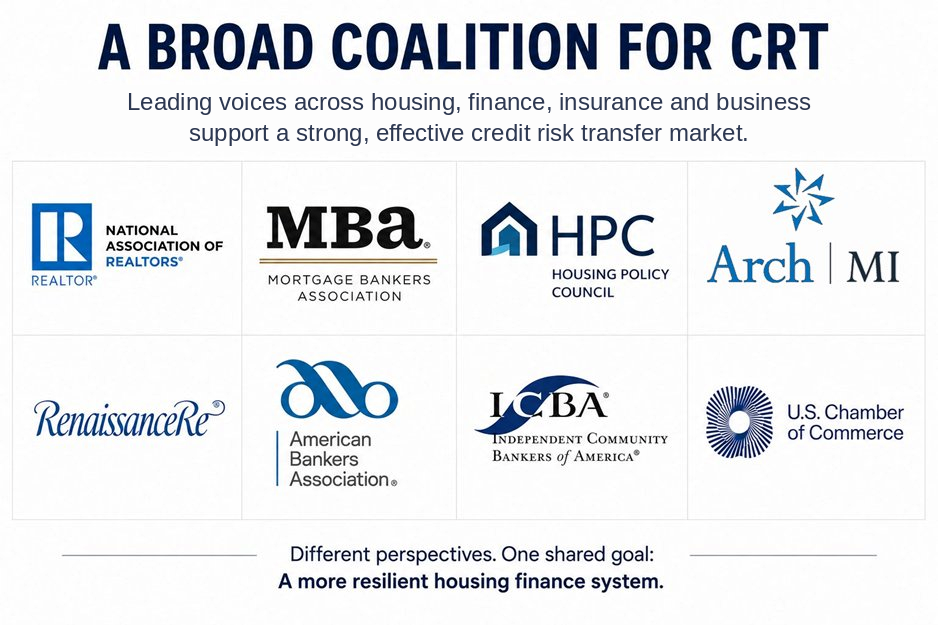
CRT is one of the rare housing finance topics where Republicans and Democrats nod in the same direction — and where the trade associations behind them line up as well.
On Capitol Hill: Last summer, Sen. Mike Rounds, R-South Dakota, and Rep. Mike Flood, R-Nebraska, chairs of the relevant Senate and House subcommittees, sent a bicameral letter to FHFA Director Pulte commending his commitment to CRT.
“Housing affordability and system stability are top priorities for Americans today,” they stated in the letter. “De-concentrating mortgage credit risk away from the government to willing private sector participants through CRT can promote both of those goals.”
On April 22, the House Subcommittee on Housing and Insurance held a hearing titled “Diversifying Risk: The Benefits of Reinsurance and Credit Risk Transfer.”
What They’re Saying:“Risk transfer tools … and reinsurance and Credit Risk Transfer all help answer that question on who picks up those losses by bringing private capital in before losses fall on the backs of taxpayers.” — U.S. Rep. French Hill, R-Arkansas, Chairman, House Financial Services Committee.
Three letters in the last few months tell the story:
- The National Association of Realtors® (NAR) wrote the subcommittee that CRT “should play a key role if the GSEs are released from conservatorship” and urged Congress to consider “entrenching and codifying the CRT and reinsurance programs.”
- A joint industry letter from Arch Mortgage Insurance Company, the Housing Policy Council, the Mortgage Bankers Association and RenaissanceRe made the case in even sharper terms (more on that below).
- A separate February letter to bank regulators on Basel III Endgame, signed by six bank trade groups, U.S. mortgage insurers and the U.S. Chamber of Commerce, explicitly cites CRT as one of the post-crisis reforms that has “deepened the pool of private capital available to absorb losses.”
When Realtors, community banks, big banks, the Chamber, mortgage insurers and reinsurers all sing from the same hymnal, Washington should pay attention.
3. CRT in Stress: The COVID Test

A favorite line of CRT skeptics is that the program looks good in calm waters but won’t perform when it matters. The data says otherwise.
By the numbers:
- Insurance-based CRT supplied nearly 40% of GSE risk transfer protection during the COVID-19 pandemic, which was well above its historical share.
- Fannie Mae and Freddie Mac have transferred more than $100 billion of risk to the private sector through the transactions.
Why it matters: CRT’s two main channels, capital markets and insurance, are complementary, not redundant.
- In good times, capital markets investors do most of the lifting. In rocky times, insurers step up.
Think of CRT as a financial shock absorber — and a resilient housing finance system is supposed to have one.
- But here’s the warning: A founding architect of GSE CRT is sounding an alarm.
Layton, who, in 2013, launched the first GSE CRT deal, published a paper for New York University’s Furman Center in December 2025 with a title that says it all:
His diagnosis: FHFA’s 2020 capital rule — the Enterprise Regulatory Capital Framework, or ERCF — contains a built-in “anti-CRT bias,” Layton argues.
- Non-risk-based “buffers” and discretionary minimums override the actual economics, so CRT transactions that should be done don’t get done.
- The April 22 industry letter’s complaint about rising “attachment points” is one symptom of the same disease.
The bottom line: The GSEs are quietly retaining more credit risk on their own balance sheets than they were a few years ago — a quiet rollback of one of the most successful post-crisis reforms.
Engage with Capital Commentary

Share your thoughts: We invite you to click here and share your insights on this issue.
Explore Arch MI Insights: Want to dive deeper? Click here to access past issues and listen to previous episodes of the Arch MI PolicyCast podcast.
4. The Next Frontier: CRT for Banks

If CRT works for the GSEs, why not for banks?
The setup: U.S. bank capital rules don’t recognize insurance-based CRT as risk-mitigating for capital purposes, even though Basel III internationally recognizes credit protection from prudentially regulated insurers.
- By the numbers: The European Union has a robust Significant Risk Transfer (SRT) market — Europe’s regulatory cousin of CRT. Arch Insurance (EU) dac — a sister company to Arch MI — alone has completed more than 30 credit-risk transactions with banks in 15 countries.
What that means in practice: A U.S. bank that wants to lay off mortgage credit risk to a well-capitalized insurer gets no regulatory benefit for doing so.
What they’re saying: From the April 22 joint industry letter to the House Subcommittee:
“Allowing well-capitalized insurers to provide credit protection to banks would, similar to the benefits realized by the GSEs, reduce systemic risk by diversifying bank risk, enhance resilience and support affordable credit without increasing systemic risk.”
- The Basel III Endgame opening: The February letter from the broader bank-and-housing coalition urges regulators to use the current Basel III Endgame reproposal to fix this by “providing banks with predictable capital relief for the loss absorption value of credit risk transfers” and by recognizing “strong insurance counterparties” as eligible guarantors.
The bottom line: The same logic that took risk off taxpayer balance sheets at Fannie Mae and Freddie Mac can take risk off bank balance sheets without compromising safety and soundness.
- International peers allow it. U.S. banks need the same ability to shift credit risk to private investors, including insurers. Without insurance CRT, U.S. banks are at a disadvantage relative to European institutions that can price their loan products more competitively.
5. My Thought Bubble
CRT isn’t sexy.
- It will never trend on social media. No senator will give a barnburner of a floor speech about Connecticut Avenue Securities.
But it works.
CRT shifts risk away from taxpayers, attracts private capital and operates in a commercially reasonable way. In a moment when the conversation around Fannie and Freddie is dominated by louder questions, CRT is the one piece of the architecture quietly doing the work.
What they’re saying: In an interview on CNBC this month, FHFA Director Bill Pulte made clear his vision that private capital is the key to ensuring a vibrant and stable housing finance system.
“We want to see a housing finance system where private capital — not the taxpayer — is the first line of defense,” said Pulte.
The risk going forward is not that CRT will be repealed. It’s that it will be quietly strangled through high attachment points that discourage meaningful risk transfer and by capital rules that penalize it.
That would be a self-inflicted wound at the moment the housing finance system needs every shock absorber it can get.
The bottom line: The opportunity, through the Basel III Endgame reproposal and through whatever shape GSE reform takes, is the opposite: Codify what’s working and extend it where it isn’t yet.
6. We Get Letters: Home Location Shouldn’t be the Only Consideration

Last month’s Capital Commentary featured a University of California study with a blunt finding: if you can’t afford to live near work, your commute gets longer. That piqued Daniel Nunes’s interest.
Nunes is a loan officer for Alcova Mortgage, based in Roanoke, Virginia, and he wrote to say he sees the tradeoff between home prices and travel distance up close. The cost savings on a home, he says, is just the tip of the iceberg.
What he’s saying: “Purchasing a home becomes more affordable by ‘qualification’ standards on paper,” Nunes told me.
But on paper isn’t the same as in practice.
The big picture: Nunes ticks off the hidden costs. “The commutes they are taking are probably more than 1.5 hours each way. What is the cost in gas? What are the extra maintenance costs on your car?”
Why it matters: Gas and maintenance costs don’t show up on a credit report — and don’t get factored into the debt-to-income ratio that lenders use to qualify a borrower.“You qualify to buy now,” Nunes wrote. “But your expenses, in all probability, go up.”
The bottom line: Those extra costs — to say nothing of the toll on work-life balance — can push commuters toward delinquency and foreclosure, Nunes contends.
See an item that piques your interest? Write to me about it.

About Arch MI’s Capital Commentary
Capital Commentary newsletter reports on the public policy issues shaping the housing industry’s future. Each issue presents insights from a team led by Kirk Willison.
About Arch MI’s PolicyCast
PolicyCast — a video podcast series hosted by Kirk Willison — enables mortgage professionals to keep on top of the issues shaping the future of housing and the new policy initiatives under consideration in Washington, D.C., the state capitals and the financial markets.
Stay Updated
Sign up to receive notifications of new Arch MI PolicyCast videos and Capital Commentary newsletters.