
Greetings from Dublin, Ireland, where the Guinness is stout, the welcome warm, the weather damp and financial services regulators are divided on the answer to a simple question: “Who is allowed to hold transferred mortgage credit risk?”
There’s an old Irish saying: Ask three people for directions, get three different roads. That’s the conundrum facing mortgage insurers operating in the United States and the European Union.
- I’m here attending the twice-annual Eurofi (pronounced ‘EURO-fee’) Financial Forum, the continent’s largest gathering of finance ministers and regulators, financial services attachés and Members of the European Parliament.
- The future of protecting banks’ mortgage credit risk is a frequent topic of conversation in meetings between industry reps and government officials at the conference.
Why it matters: Same asset. Same risk-transfer logic. Three verdicts. The differences shape how much banks lend, what borrowers pay and where risk ultimately lands.
Even the jurisdiction furthest ahead is quietly tripping over its own reform. So, pour yourself something and let’s get into it.
1. America’s Door Left Ajar: Private MI
The U.S. Basel III Endgame regulation proposed last spring offers no capital relief to a bank that credit-enhances a high-LTV mortgage with private mortgage insurance. Private MI (PMI) sits in a first-loss position on the riskiest loans.
The door isn’t locked, it’s ajar. And the story still might have a happy ending.
- That’s because regulators explicitly asked whether banks should get recognition for PMI and, if so, how to calculate it.
Why it matters: A borrower with a high-LTV loan effectively pays for the same risk twice; once in MI premiums and again in the higher cost of capital the bank passes through in the loan rate.
Banks might also reduce their lending to borrowers unable to make large down payments without capital relief for loans enhanced with MI. That would reduce competition in the mortgage market, driving prices higher.
What they’re saying: Housing groups weren’t shy in telling the regulators their proposal was misguided in regard to the treatment of Private MI.
Arch Capital Group argued that the regulations would “treat insured and uninsured loans at the same LTV as presenting identical risk,” an assumption “directly contradicted by decades of historical performance data.”
USMI, the industry trade association, points to the framework the government already trusts: FHFA’s Enterprise Regulatory Capital Framework (ERCF) that “recognizes the loss-severity-reducing impact of private MI and provides capital relief accordingly.
- USMI cited a Milliman® analysis of more than 90 million loans that found that mortgage insurance cut net loss severity on high-LTV loans (> 80% LTV) below that of the 60–80% bucket of loans.
2. America’s Door, Left Ajar: CRT
The regulatory divide on protecting credit risk doesn’t end at the treatment of private mortgage insurance.
The deeper exclusion: Insurers don’t qualify as “eligible guarantors” to U.S. banks. It is a categorical exclusion, not a calibration question.
Why it matters: The U.S. government’s own housing finance arms — the Government Sponsored Enterprises (GSEs) regulated by FHFA — do what bank rules forbid. And they have since 2013.
- Roughly 40% of the risk shifted from Fannie and Freddie through credit risk transfer (CRT) is held by insurers. The other 60% is transferred to capital markets investors.
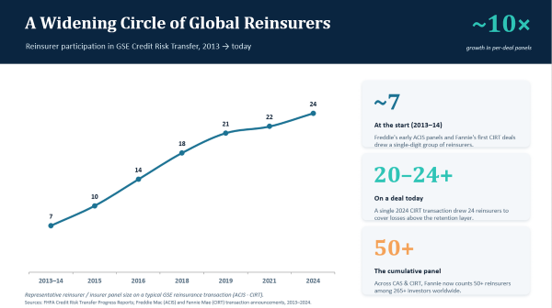
By the numbers: Seven reinsurers participated per deal at the start of the CRT programs.
- By 2024, as many as 24 participated in a transaction.
- There are now more than 50 cumulative reinsurers active in Fannie and Freddie CRT transactions.
Complementary pair: Insurance companies prefer long-duration assets like mortgages while most capital markets investors prefer shorter-term assets. It’s why the option to use either as a source for credit protection works so well.
The bottom line: During the COVID-19 pandemic, the capital markets turned turbulent. Reinsurers stepped up to fill the void with GSE CRT, growing the share of so-called “unfunded” transactions to 40%, up from 25%.
The contradiction: U.S. taxpayers back both banks and the GSEs. Yet insurers aren’t eligible to take on bank credit risk while a significant share of GSE risk is now held by insurers.
Why is an insurer good enough for Fannie and Freddie but not the bank down the street?
3. Europe’s Door Opens … But Could Be Wider
Europe runs CRT through “significant (or synthetic) risk transfer (SRT).” Insurers provide unfunded protection on certain deals that enable banks to lower capital requirements on transferred risk.
What’s live: The European Union (EU) is debating whether to extend its “gold-standard” Simple, Transparent and Standardized (STS) label to credit protection offered by insurers. That would correct a 2021 securitization framework that shut insurers out of the category.
Why it matters: A credit transfer labeled as STS provides greater capital relief for banks and could encourage them to offload more mortgage risk to long-duration investors. In addition to banks, mortgage borrowers expect to benefit from such expansion.
The big picture: Mario Draghi, the former Prime Minister of Italy and former President of the European Central Bank, published a paper in 2024 urging the EU to revive securitization to enhance financial competition with the U.S.
- The European Commission, which writes legislation, submitted its proposal in mid-2025 calling for expansion of the STS label to insurers.
Yes, but: Europe is genuinely ahead of the U.S. in this instance. But its lead comes with a self-inflicted limit.
Safeguards or roadblocks? The reform currently moving through the European Commission, European Council and the European Parliament — together, they enact legislation through “Trilogue” negotiations — would restrict STS eligibility to EU insurers, using a size threshold of €10 billion in total assets.
- The problem: Under that scenario, only two of 12 insurers now active in the SRT market would qualify.
- Two is not a market. It concentrates risk in a handful of balance sheets, which is the opposite of what SRT is designed to achieve. Moreover, banks would quickly run up against risk limits.
Constraining contrast: The GSEs work with 50-plus reinsurers. The EU’s STS reform, as drafted, would clear two.
- The bottom line: One system recognizes the value diversified global reinsurers bring. The other, at the STS level, treats non-EU groups with suspicion.
The ask in Dublin: Let an EU-authorized and regulated insurer count the consolidated assets of its parent group where that group is subject to “Solvency II-equivalent” supervision.
- The protection provider stays an EU-authorized insurer subject to capital, governance and reporting requirements.
- It is limited to insurer groups based in Bermuda and Switzerland. The EU previously determined that regulatory oversight in those countries must meet standards set by the Union.
What it means: This single change would widen the eligibility pool from two to six or seven insurers — in other words, a competitive and robust market.
4. The Home Stretch
On both sides of the Atlantic, policymakers are quickly putting the final touches on banking and insurance regulation.
What’s next:
- Proposals to reduce barriers to insurer participation are expected to be offered by at least one of the EU’s 27 member states at the European Council’s next working group meeting later this month.
- The European Parliament finished its legislative work on securitization reform in early May. The Trilogue is expected to wrap up its work in October.
- In the U.S., banking regulators are expected to finalize the Basel III Endgame by year’s end.
The next Eurofi will be held in March in Lithuania, which takes the reins of the EU Presidency from Ireland on Jan. 1, 2027.
The question worth watching: Will financial services regulators on both sides of the Atlantic recognize the comprehensive benefits of transferring credit risk from banks to insurers by then?
Engage with Capital Commentary

Share your thoughts: We invite you to click here and share your insights on this issue.
Explore Arch MI Insights: Want to dive deeper? Click here to access past issues and listen to previous episodes of the Arch MI PolicyCast podcast.

About Arch MI’s Capital Commentary
Capital Commentary newsletter reports on the public policy issues shaping the housing industry’s future. Each issue presents insights from a team led by Kirk Willison.
About Arch MI’s PolicyCast
PolicyCast — a video podcast series hosted by Kirk Willison — enables mortgage professionals to keep on top of the issues shaping the future of housing and the new policy initiatives under consideration in Washington, D.C., the state capitals and the financial markets.
Stay Updated
Sign up to receive notifications of new Arch MI PolicyCast videos and Capital Commentary newsletters.